
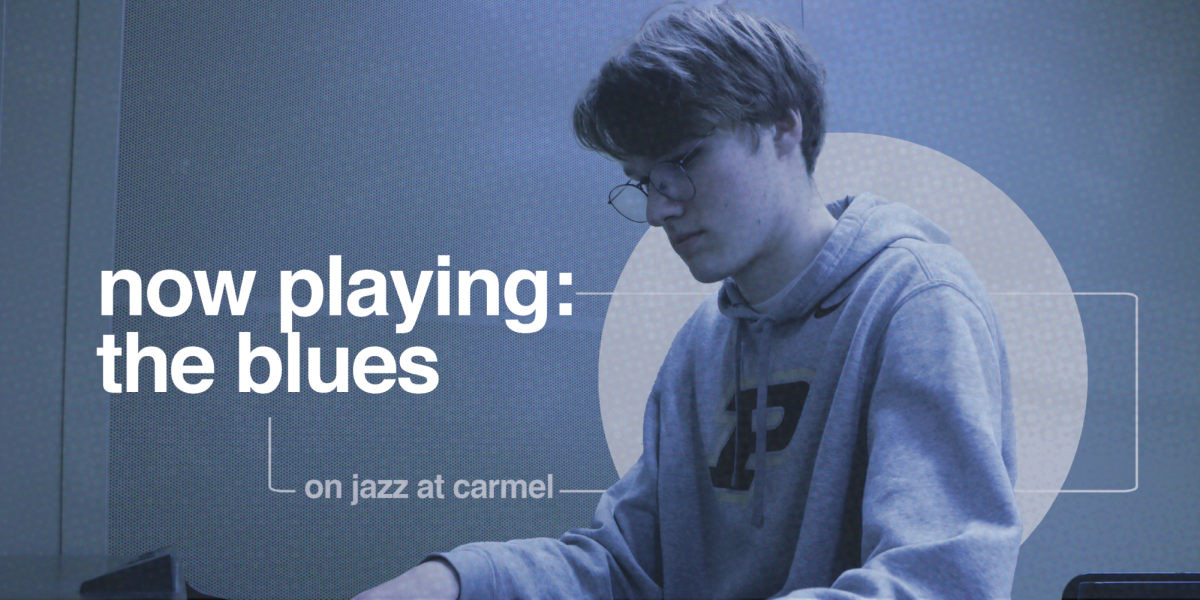
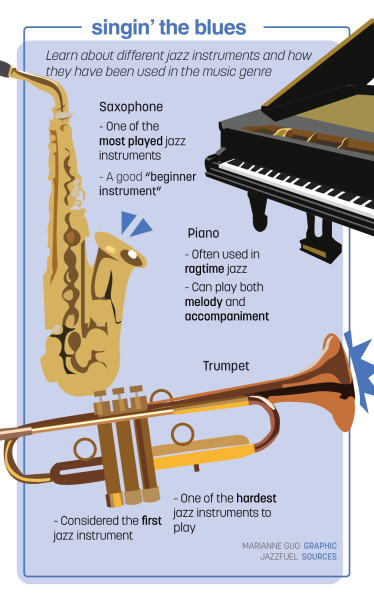
 Blues and jazz music are often regarded as an outlet for self expression through leaving music written on a page and playing from the heart. The blues’s rich cultural background contributes to its distinct feel, and the emotion behind it.
Saxophonist and junior Jackson Yates said his experience in Carmel high school Jazz Band exposed him to playing the blues.
He said, “Part of the thing that really speaks to me with jazz and the blues is the creativity. It’s like speaking your mind through music. The only time I really enjoy what I’m doing is if I feel like (the music) is flowing through me, rather than thinking, ‘this is what’s on the sheet, so this is what I’m going to do.’ Rather, this is a piece that I’m going to perform my way because I have the opportunity to make other people feel as I feel with a piece, instead of them listening to a piece I’m playing just because I have to.”
The creativity aspect of the blues can derive from improvisation, in which musicians use the notes from a specific scale to play anything they want. According to Pianote, the blues structure is based on a 12-bar chord progression utilizing the blues scales, or the root, minor third, fourth, flat fifth, and minor seventh.
Elijah Jones, jazz musician and senior, said, “What blues has to do is tension and release. So, a lot of the time, you’re either playing a minor blues scale or a major blues scale or a multitude of different pentatonic scales, which you’ll switch between to make it sound bluesy. Bending the note also helps.”
Yates said, “(The blues) has this feel to it, no matter what the tune is, if it’s 100 miles an hour or at a snail’s pace, or uses whatever different kind of blues chords, you can listen and go, ‘that’s a blues scale.’ It has a certain feel to it that other pieces don’t replicate.”
This structure was born in the Mississippi Delta and across the American south during the late nineteenth century, according to The Open University. Emerging from African American work songs, the blues incorporates African musical traditions as well as American folk styles to tell a story of resilience. The blues later spread with African Americans to urban centers, such as Chicago, Detroit and St. Louis, influencing other genres of music as well.
Conner Granlund, performing arts teacher and director of Jazz ensemble 2 said he frequently uses the blues in the pieces he teaches.
“(The blues) is the fundament, it’s the base of everything that we do,” he said. “The first form of jazz music was blues music in the 1920s. It’s really tough to play any concert without a blues tune in some way. It might not be explicitly a blues, but the chord progression that you solo over might follow a blues progression. For instance, Jazz 2 is doing “Backbone” by Thad Jones, which has a blues solo section. I would guess every other Jazz Band in some way ties back to that because it’s our cornerstone of the jazz area, that blues scale and using that to improvise, which you can use over any solo section.”
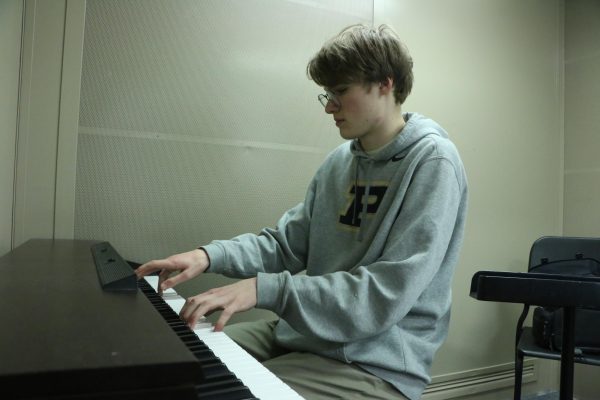 Jones said, “Blues has been the forefront and foundation for almost all American genres. It is a melting pot. It kind of illustrates the whole idea of a melting pot in America by being such a big culmination of multiple different cultures, from Asia to Europe to Africa to South America. It originates from African traditional music and ragtime, which then turned to jazz, funk, rock. Rock would later turn to metal, and a lot of rock would also turn to pop and soul. So almost all American-based genres can trace their origins to blues.”
Because the blues is an art form underlying so many genres, its widespread use causes opportunities for easy connection among musicians. The simplistic scale and progressions also make it available to a wider range of skill levels.
Yates said, “The blue scale is a good entry point to people like me and a lot of people at Carmel who are very classical brained. It opens the door to improvisation, which is not an easy thing for some people who have been so wired to play exactly what’s written on the page.”
Granlund said teaching the blues scale would often come as a first step when encouraging his students to improvise.
“The blues is a great starting place for improvisation,” he said. “It’s six or seven notes most of the time, and that’s what you can use to sound good over the whole solo section and then however much more you want to go past that. You can dive into one specific chord and play your blues scale, but on that one chord, you throw in a note from the chord and you keep doing that through all of it. So it’s a really good entry point for everybody, which is why it’s so accessible because you can use that for any solo section.”
Jones said his experience using the blues to play jazz with friends as well as in Jazz Band allows easier connection among musicians.
He said, “The blues is such an extreme means of expression to me. It’s through being able to play the blues and connect with others, because it’s such a communicative experience to play the blues. It creates a lot of great personal connections. A lot of the time, if you just say ‘let’s play a blues tune’ everyone will be able to play simple twelve-bar blues together, and it’s a really easy way to play as a group.”