


For junior Gabriela “Gabby” Rodriguez-Gonzalez, navigating the online news sphere had often led her down rabbit holes of confusion and strong emotional entanglements.
She said the algorithm on platforms like Instagram and TikTok place fervent emphasis on pushing extremely polarizing content intended to chase engagement.
“A lot of times when I’m seeing these videos, I know it’s purposely making me feel upset, angry, and enraged. It creates so much fury at the world around myself, especially when it comes to pointing fingers and putting people at fault,” said Rodriguez-Gonzalez.
She said she unconsciously relies on social media as one of her main outlets of receiving her everyday news, and according to the BBC more than half of Americans receive their news through social media.
Rodriguez-Gonzalez isn’t alone in her dissatisfaction with the narratives she’s constantly bombarded with. As reported by the American Psychological Association, the “media overload” facilitated by social media platforms carry the potential to be incredibly harmful toward teens and young adults.
Hillary Yang, prospective computer scientist and senior, said she relies on a more apathetic stance amid the influx of sensationalist content on her for you page.
She said, “As a citizen of this country, it’s my duty to be informed on (current events) so I can take a stance on them, be educated and maybe make an impact someday. But I try not to let it affect me too much.”
Yang said overall, the type of content pushed on social media tends to weigh less on the reliability scale. That’s why she said, “When it comes to social media, it’s a lot harder to find that distinction just because so much content is being put out, and no one can really verify anything.”
With audiences constantly overwhelmed with sensationalist content and left to ponder the credibility of the news, it leads to the question–what does it take to make it in the news industry?
Igniting polarization
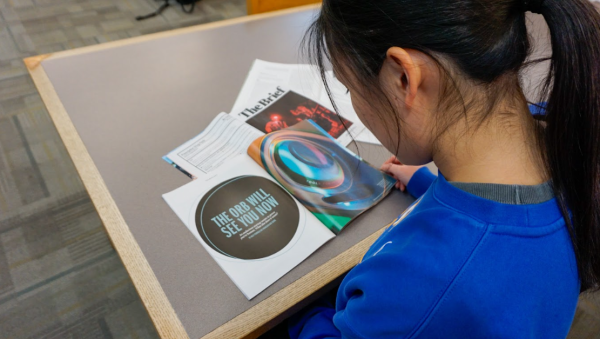
According to Clayton Baumgarth, multimedia reporter for the WFIU, an NPR/PBS affiliate broadcasting station, “(Many news outlets) are trying to make their buck and that’s the system that’s been set up through social media,” he said, “It’s disheartening because with a lot of these things, a simple Google search; looking at other sources, going straight to other news outlets and cross referencing stories, a lot of what you see on social media can be pretty quickly disproven if you take the time to do so.”
Baumgarth said polarizing content tends to garner the most viewership despite it not typically capturing the full truth. “When people disagree, they’re more engaged with content, if there’s content that’s divisive or, you know, there’s an issue that’s being talked about and people are fighting in the comments, that’s pretty beneficial to a lot of these companies,” he said.
Reflecting on teen and young adults specifically, Rodriguez-Gonzalez said she is concerned about similar issues pertaining to the tendency to sensationalize based on polarization. She said she feels that a lot of students are losing their ability to develop their own thoughts about certain topics,
“A lot of times seeing what comes across online about news, it’s mostly very opinionated, very biased information. A lot of times that creates ideas that are almost copy-pasted onto the student’s minds,” she said, “ A lot of students are on one side of the spectrum on certain issues because that’s what their for you page shows them.”
Moreover, Baumgarth said an abundance of what audiences consume very commonly reinforces their worldview or their political affiliation, subsequently making it extremely easy to believe the exaggerated truth.
He said, “It’s incredibly easy to fall into your own echo chamber, see something you agree with, that must be true, and then just pass it along without even taking a second guess. So it’s our job as journalists to present the facts and to tell the truth even when it’s not convenient.”
Yang mirrored a similar idea and said, “I think something that’s been going around a lot is this idea of an echo chamber. For example, Instagram’s gonna show you what you’ve been liking and that’s always going to be like. It’s not really a good way to get an impartial view of what’s going on. Many readers just take away a punchy headline.”
Baumgarth said, “It’s all a business at this point and, and stories are the currency.”
Does AI erode public trust in journalism?
According to Baumgarth, as of right now, the news industry is still navigating different means of leveraging AI, for the most part, organizations remain tentative about establishing strict policy, there’s overall a lot of hesitation.
“Putting fact-based reporting at the hands of AI has a chance of eroding public trust in a time when public trust of media in general is already pretty low,” he said,”In my personal experience, I use it a little bit on my projects to help me get transcripts for my interviews that I did.”
Yang, a prospective computer scientist, said it is hard for her to weigh the moral and ethical contentions of using AI for different projects.
She said, “For technical use like writing code and solving math equations, I feel like that’s okay by me, but when it comes to creative disciplines, like art or generating videos, that’s I think where it gets a little blurry.”
Looking to the future Yang said, “These large language models and vision language models will have so much potential to take over our lives and some of those impacts might not be too good. AI is kind of scary with how it’s proliferated, but I do think it’s in general for the better.”
Looking ahead
Yang said she acknowledges that media literacy, in particular, isn’t a subject that can be taught in school, it’s a learned skill that audiences need to develop in order to be informed citizens.
Baumgarth said, “It’s important that people become really good at discerning when they’re being sold something or when there’s an advertisement snuck into their content. We rely on people to be more aware of what they’re reading, where it’s coming from and who’s writing it. It’s going to put more work on the public to make sure what they’re seeing is true”
Besides from the audience’s responsibility to exercise literacy, he said the country and the people are so heated on every issue it seems it’s really hard to talk about anything without there being some two-sided argument being presented.
“I think that (journalist’s) job in today’s day and age is working on depolarization, we need to work on understanding that people are complex and that the fringes of either side of the political spectrum don’t always represent the majority of people,” Baumgarth said, “We need to do a better job of telling stories that reflect that idea that that paint people as complex and nuanced.”